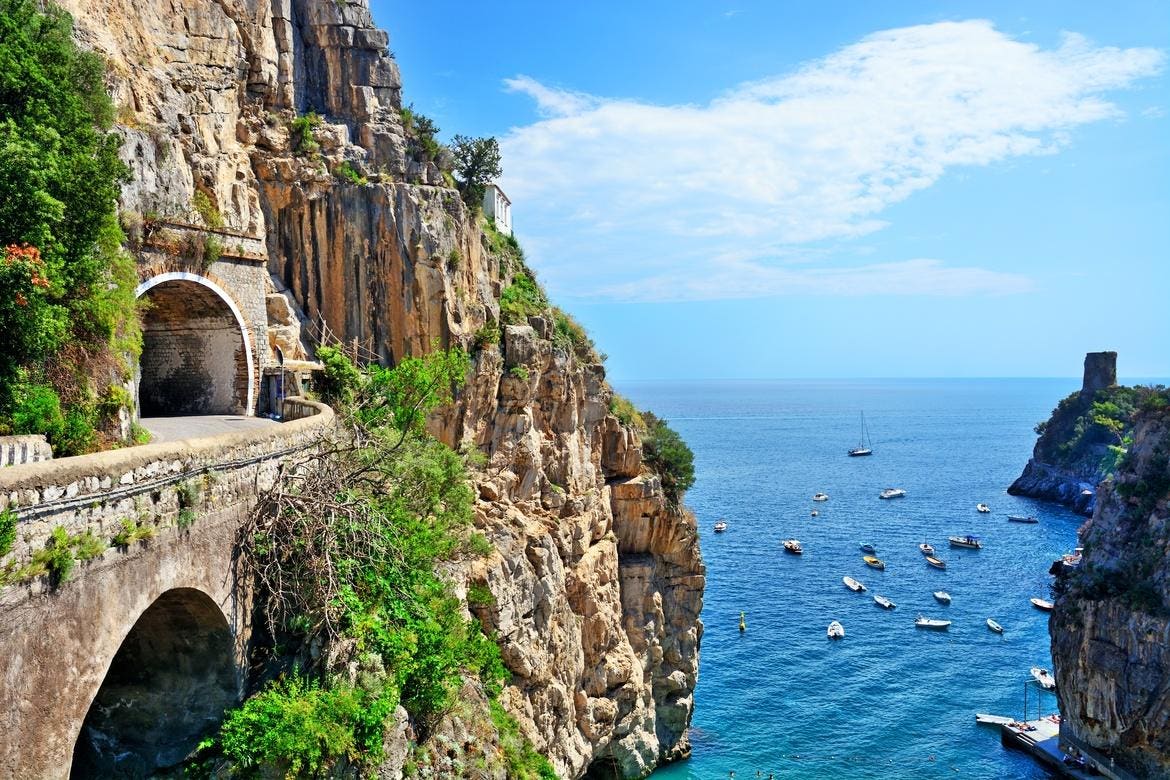
Picturesque tunnel on the road of Amalfi Coast, Campania, Italy
getty
I just watched the opening sequence of Hotel Costiera, the new Amazon series starring Jesse Williams as an ex-marine -cum- fixer at a luxury hotel on the Amalfi Coast. For a few glorious minutes, Williams cruises down an empty Strada Statale 163 on cherry red Vespa Primavera – no cars, no people, just curves and sea. Add some lemons and you have the Amalfi Coast dream.
Reality, of course, is a bit different. The SS 163, famous for its cliff-hugging curves from Punta Campanella to Vietri sul Mare, becomes a frustrating parking lot from June through August, as everyone swarms the coast’s charming towns like Positano. Ravello,Furore, Cetara and Nerano.
“Overrated,” “Overcrowded,” “Why I’ll Never Go to the Amalfi Coast Again,” warn the headlines. They’re not wrong. A few days on the Amalfi Coast can be exorbitant, congested, and relentlessly overshared on Instagram and TikTok. But after five days of full immersion research, I can definitely say it is worth it – at least once in your life.
Amalfi Coast Beauty That Breaks Your Heart (And Maybe Your Wallet)
The Amalfi Coast is undeniably glorious and heartbreakingly beautiful, which is why it draws hundreds of thousands of visitors, like myself, to its craggy coastline each summer. Even dead stopped in traffic on the way to Praiano, we were smiling and couldn’t stop commenting on the view. With each curve, a colorful town emerged, terraced gardens unfolded and beach clubs dotted the coast line, all backdropped by sapphire blue.
Even more irresistible is the microclimate, a basin of sunshine , salt air and warm winds that produce a cornucopia of cherished produce and artisanal products, and homegrown chefs who helm humble beachside restaurants and Michelin stars. No one where is there more deserved culinary heritage pride than here – the land that gives us Gragnano pasta, mozzarella di bufala, limoncello, Re Umberto tomatoes, and colatura di Alici di Cetara, to mention a few, as well as freshly made pasta like scialatielli, and ndunderi, and about a thousand ways to pair pasta with seafood.
But the coast costs. Since the early 20th century, a who’s who of glitterati like DH Lawrence, Greta Garbo, Jackie Kennedy, and Sofia Loren have put in time on the costiera, and wherever they went, everyone followed. Add a Jenner Kardashian birthday party, and it’s no surprise that a night at any four and five star hotel in high season can start at four figures. Likewise everything else that comes with your stay – from spritzes to beach beds – is priced to match.
Where to Stay On The Amalfi Coast
Hotel Santa Caterina
If I had to live in a hotel, I would chose Amalfi’s Hotel Santa Caterina. With more than a century of history, this is the grand dame of Amalfi hospitality.- elegant, graceful, and old world. Its 92 rooms spread spill down the main building through two hectares of terraced gardens into bungalows, all styled with hand-painted tiles, vintage furniture, and sea views.
Hotel Santa Caterina has been part of the Gambardella family for four generations so it makes sense why the atomsphere is so cozy and homey, even as as its expands with three contemporary-styled villas at the north end of the gardens. Staff remember not just your name but how you take your espresso at the silver-service breakfasts, another reason it holds two Michelin Keys.
Our favorite time of day was anytime we walked down to and back from the private beach club. The experience could make for a romance novel cover- lemon trees, vine-covered pergolas, arched loggias and mediterranean blues.
Starting at$1965
Amalfi from Hotel Santa Caterina
Erica Firpo
Casa Angelina
The first time I visited Casa Angelina I fell in love with its palette – a symphony of whites. The hotel is not one singular hue, instead, the white palace is a mosaic of at least fifteen different shades of white which mirror the shifting Mediterranean light and are touched up everyday. Something about its fidelity to white was meditative, and this visit, it dawned on me that this white-on-white world brought out every hue of blue- cerulean, pthalo, indigo, navy – from the Tyrrhenian Sea.
Calmness is key at Casa Angelina, which is one of the factors that contributes to its Michelin Key. In the daytime, it’s a vertical oasis set about 200 steps from seas -nestled in a Praiano neighborhood but yet entirely private. At night, it is a stargazer’s paradise as the sky moves into an inky onyx. I spent my nights bare-eying Betelgeuse, Sirius, Arcturus and the Pleiades as they moved toward the Monte Lattari. But Angelina’s two best weapons in its meditative arsenal are its terraced gardens (which feel about 10 degrees cooler than than the beach) and the on-call water taxi service that takes you up and down the coast.
Starting at $2229
Borgo Santandrea
We left our car in Borgo Santandrea’s driveway. And like most Amalfi Coast driveways, it sits at the top of the property, a tease of what’s below. With no expectations, I descended into a dream carved into limestone. We were only day-trippers, specifically intent on enjoying spaghetti con vongole at the Beach Club
For us, Borgo was illicit escape. We sunned on its pebbled beach until hunger pulled us to the beach club restaurant. The mood was pure Gatsby- glamour edged with secrecy. Set in a private cove in Conca dei Marini, feels utterly apart from the rest of the world – with its two Michelin keys, it’s clear that the secret is out.
After lunch, I toured the property – a vertical labyrinth of 52 rooms and suites unfold down the cliff, decorated with mid-century ceramics, travertine, and pale wood, and distinct blue and white tiles in each room. All views with one purpose – the sea.
Starting at $2213
Where To Eat On The Amalfi Coast
My rule of thumb for the Amalfi Coast (and Campania in general), is simple: you can’t go wrong when it comes to food. Like every good Italian beach community, you’ll find beach-club restaurants serving perfect scialatielli ai frutti di mare, Michelin-starred rooftop restaurants with views made for champagne toasts (all three hotels boast Michelin stars, and each is lovely), and tiny trattorie turning out the best frittura di mare of your life.
Spaghetti con vongole at Alici, Borgo SantAndrea.
Erica Firpo
For me, though, whether chintzy beach club or Michelin star, my priority insalata caprese, an iconic dish in Campania made with thick slices of cuore di bue (ox heart tomatoe) and mozzarella di bufala, with drizzle of local olive oil and a hint of salt air. I decided I would try it at every opportunity, and no food outpost disappointed.
While I could have lived on caprese alone, I discovered that my idea of fun was to hop a gommone (small boat) and head to any little cove restaurant, In my black book are Da Armandino in Marina di Praia for spaghetti alle vongole, and Il Pirata, tucked beneath Praia’s cliffs, for grilled fish under tea lights. We were charmed, as I am sure you can be with any seaside restaurant, but we also left a night for the fabulous rooftop restaurant Un Piano nel Cielo (at Casa Angelina) where chef Leopoldo Elefante brings the entire garden to the table in whimsical, Amalfitana dishes.
Get Past the Crowds
There’s plenty to do on the Amalfi Coast – hiking, music festivals, wine tastings, boating – if you’re the type who needs an itinerary. I’m not. Give me a sun bed, a book, and obviously an insalata caprese, and I’m good. Still, after a few days, we decided we wanted a town excursion.
Piazza del Duomo Amalfi, Italy
getty
Our choice was obvious: Amalf. Once a rich maritime powerhouse, with a phalanx of ships , today the tiny town i is the epicentre of the coast’s tourism. The main square is also the main meeting pointing for most of the coast’s boat and bus transfers, which means you have to force a little elbow room to experience Amalfi’s true beauty.
Start at the Duomo di Sant’Andrea, Amalfi’s medieval cathedral that dates back to the 6th century, recycled and rebuil in the 13th to hold St. Andrew’s relics from Constantinople. Arab, Norman, and Baroque layers gild its history in 24-karat gold. The main church quiet in its restraint, which only sharpens the shock of what lies below: a lavishly detailed Baroque crypt.
Along with ruling the seas, Amalfi once ruled Europe’s paper. Since the 13th century, artisan have been making carta bambagina, a handmade paper pulped rags of cotton, linen, and hemp so soft. At its peak, the town had dozens of workshops handpressing paper from linen and cotton rags . Walk the Ruga Nova Mercatorum as far as it goes and keep walking until you hear the sound of running water – you can get a glimpse of production at the Museo della Carta.. This in the site of a centuries-old workshop. Today, only Cartiera Amatruda is the last remaining paper maker.
Back to the main question: is the Amalfi Coast worth the hype, the traffic, and the eye-watering price tags? This is probably best answered by the song Williams was singing in those opening minutes: Biz Markie’s Just A Friend, with that guttural line “Baby, you got what I need.” Because absolutely, yes, the Costiera has got what I need, and maybe for you too – dramatic landscape, delicious cuisine, and old world hospitality, a kind peace of that hits somewhere between espresso and enlightenment.